Thursday, July 31, 2025


Hive 4 August Tutorial

Thank you all for understanding earlier this year that I was very sick and needed a couple months off and those that shuffled so that I could have a month later in the year.  So, now it’s my turn and I created this block to use up scraps and keep it bright and cheerful. I’m calling the block, Dots.  Because that’s what it is!  Just some background with appliqued dots however, I do have a specific color scheme and applique method to use.

The color scheme uses a Split Complementary scheme of Red/pink, Blue-Green, and Yellow-Green.  The color wheel picture has the colors outlined in black and the other picture is my fabric pull. A 16” square of white on white, or white, or mostly white low volume is needed as the background. Various sizes of scraps are needed to make the 5-8 dots to be appliqued on the background.  For the color dots, I prefer prints rather than solids and the prints can combine colors as you see in the middle of mine as long as it “reads” one of the colors in the split-complimentary choices.  The dots should be about 1” to 4”. The largest dot should be in the centerish of the square and all the other dots are placed randomly across the background square.


A color wheel on a blue surface

AI-generated content may be incorrect.

This applique method requires a lightweight fusible which is one side with the bumps/glue and the other is smooth.  I am using Pellon Featherweight Fusible -911FW or Pellon SF-101 is also very popular.  If you do not have a one sided lightweight fusible, I can send you some.


This linked tutorial shows the method for applique to use; however, the shape is various circles rather than an orange peel or melon shape.

Here are some detail instructions with pictures.

Use templates or everyday objects no bigger than 4” for the largest circle in the centerish portion of the block (eyeball it is fine)– you can have multiple larger circles or small circles – totally up to you and your scraps you have available.

  • Draw circle on smooth side of interfacing.
  • Put interfacing glue/bumpy side down on right side of pretty fabric.
  • Shorten stitch length to 1.5
  • Sew with needle going through the drawn line
  • Go slow Reposition presser foot often
  • Trim to scant 1/4” around circle 


Pull up interfacing and snip middle to make slit for turning inside out 


Use purple thang (yes mines mint green) or bamboo stick or chop stick with dull end to smooth out circle


Remember to place your largest circle in the centerish part of the background square and all other circles place randomly.

Press to background – follow your interfacing instructions - If circle does not hold - use glue to attach to the white square while you stitch around to secure to background fabric


Topstitch close to edge of circle – no more than 1/8th inch in from edge – straight stitch - Aurifil colors as follows if you have it, if not any white thread for the top stitching. Natural White - 2021 or White - 2024 to top stitch around circle.


5-8 circles per square - Other circles random placement

Leave 1.5” around space at edges of block - I’ll be trimming to 15.5” so they finish at 15”.

Thanks Everyone!  I retire on 8/15 and I'm looking forward to putting this one together with all of your beautiful fabrics!

Lisa...


Hive 1 Christmas Gnomes for Beth


I don't actually have any Christmas fabric, but I hope these guys pass as a kind of cozy piney and hearthy vibe. Pictured with temporary noses until they reach their new home. I hope it won't take too long since you live pretty near me!

Sunday, July 27, 2025

2024 Hive 5 Finish

 Back in March of last year, I asked my hive for funky chickens. I finally got around to putting them together and absolutely love how bright and silly they are. Thanks to my hive mates for rocking the flock out! 


Nicole P.


Friday, July 25, 2025

Hive 1 Christmas Gnomes for Beth

 Gnome complete and will be sent tomorrow! The green looks darker in the pic than it is. 


Jai

Sunday, July 20, 2025

Hive 1 Christmas Gnomes for Beth


Hi Beth! These were a lot of fun to make! I couldn’t find my Heat N Bond, so you’ve got a pair of noseless gnomes coming your way :)

Merry Christmas in July!

Wednesday, July 16, 2025

Hive 1 July 2025 Christmas Gnome for Beth


I enjoyed making this little guy! I hope he fits in well with his gnomies :)

 --Caitlin 

Tuesday, July 15, 2025

Hive 1 - Christmas gnomes for Beth

 I got a little carried away with these because they come together so easily. This is just such a fun pattern. 

I recently made a mushroom garden quilt and included a gnome friend on it. They're so cute and versatile! 

I hope these fit well with your theme. 


Happy sewing, 
Nicole


Thursday, July 10, 2025

Christmas in July for Beth, Hive 1


Hi Beth,

Hope you like those gnomes. I've had only bits and pieces left from previous Christmas themed fabric bundles, but tried to make it work.

These guys are going into the post today to make their way over the big pond.

Happy quilting,

Rita

Sunday, July 6, 2025

Christmas Gnomes for Beth


This nose-less gnome is heading your way! 
I don't have much in the line of holiday or winter fabrics but I think this 
mid-year dressed gnome with grey haired-swirled beard should fit the vibe check. 
I'll get him dropped in the mail this week. -Tasha

Wednesday, July 2, 2025

Christmas in July for Beth

Hi Beth,
Two gnomes wearing their Christmas morning PJs are hanging on the closest thing to a Christmas tree South Florida can offer!😂
Coming your way after the 4th of July weekend,🎇🎆🎇
Marie


Tuesday, July 1, 2025

Meghan's July Block for Hive 6- Instagram

 Hi Quilty Friends! 

I hope your summer is going slow with time to sit at the sewing machine. Summer is one of my favorite times to sew. I have been working slowly on this 4th of July quilt for several years and need your help to get this UFO completed! 

The pattern I will be using for block is a free pattern from Cluck, Cluck Sew. 

https://cluckclucksew.com/2017/12/no-point-stars-a-free-printable-pattern-in-5-sizes.html

You will need three different fabrics- please use any red, white and blue fabrics you have in your stash. They can be white on white, white, low pattern white, anything that reads white. Reds can be deep to cherry reds, nothing too pink. Blues can be navy to light blues. Please stay away from teals. 

Please cut out 9- 4" squares- these will be 8 of one color and 1 for your middle block, which will be a different color. 

Please cut out 8- 3" squares, these will become the points on your no point stars 


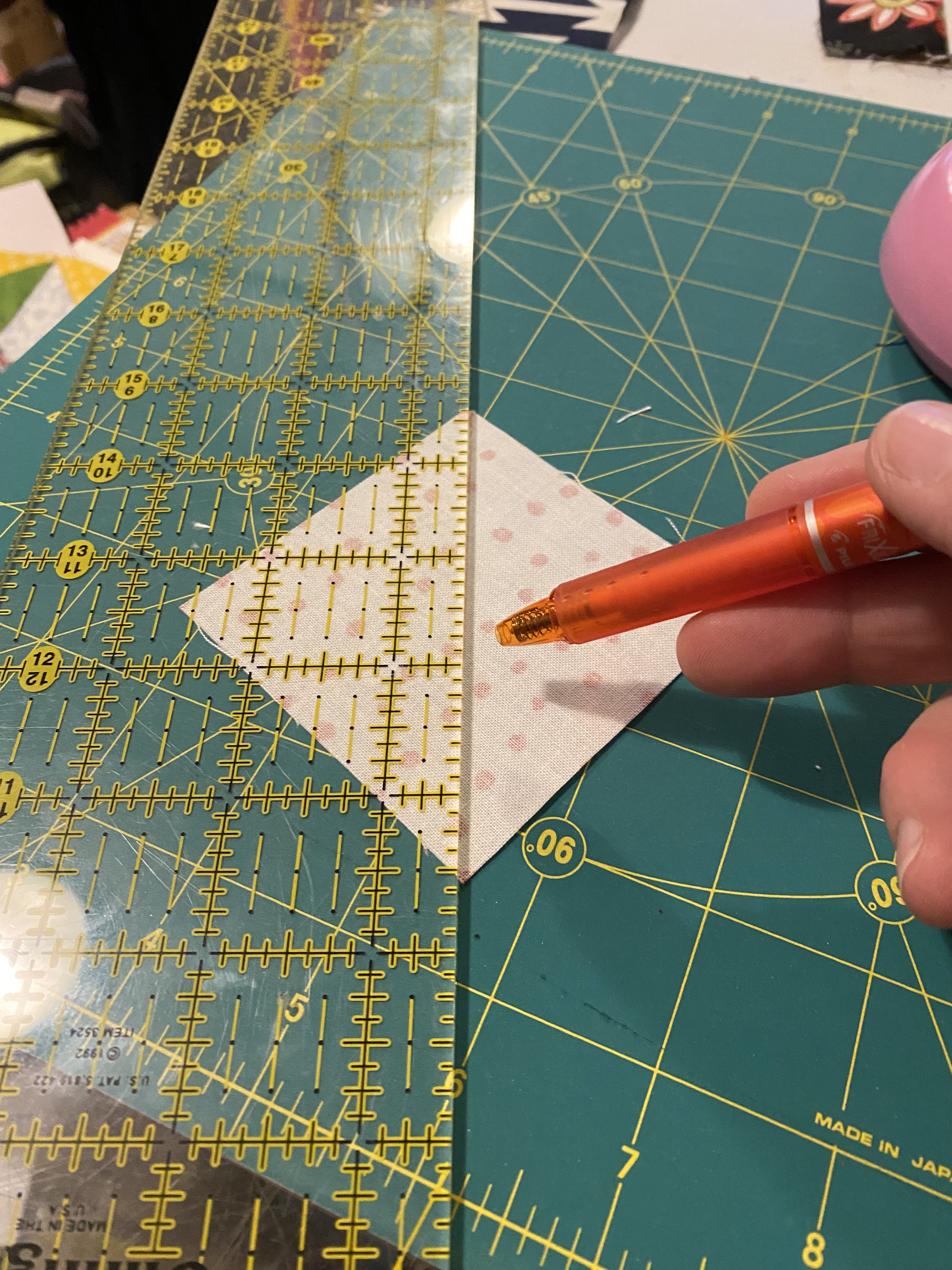
Step 1: You can draw lines down all eight of your 3" squares or use whatever method you like to use to make corners within your squares. I use the cluck cluck sew tape on my machine. 


Step 2: Sew one 3" square to a 4" square from corner to corner. Make 4 of these units


Step 3: Cut the corner off the block and leave a 1/4 inch from the seam. Press to the dark side. 


Step 4: Add the next 3" square onto the other side of the 4" square. Sew on the diagonal line. Cut off the corner of the block and leave a 1/4 inch from the seam. Repeat four times. 


Now you have your corners for the stars! It should measure 11 inches by 11 inches. 

Step 5: layout your block like a nine patch, sew together and press to the solid blocks. 


You just made a no point star! 


=


Hive 1 Christmas in July Tutorial for Beth


🎄Christmas in July for Beth🎄

This quilt will be for my niece.  She loved gnomes when she was younger, and I figured that Christmas gnomes would be a good quilt.  Even if she isn't into gnomes like she was, I thought it would still fit.  

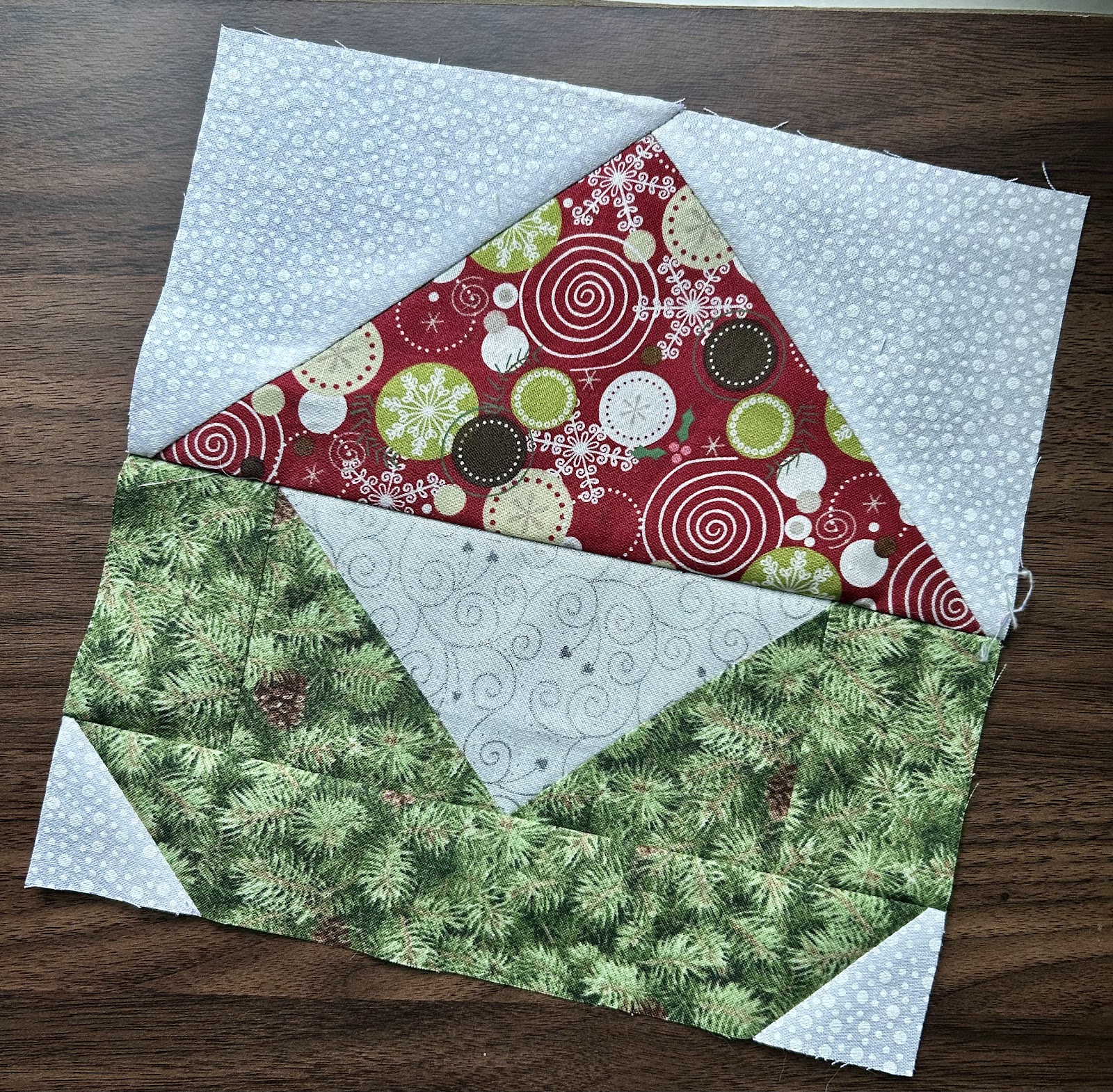
I found a gnome quilt square that I really liked from the 'Sew Can She' blog at the following link: Sew a Gnome Mini Quilt - Free Gnome Quilt Block Pattern.  I changed up the sizes of the pieces so please use the following cuts but the directions on the blog should still work.  I made a few squares at the adjusted sizes with this tutorial, and I was pleased with it (see below).  It will result in a square about 9.5" tall by 9.25" wide.  I plan on making a quilt with a number of different colored gnomes and possibly adding in a few trees.  I was thinking that it will be a throw quilt size.


Colors:

The tutorial has a blue hat and a red body (or shirt?), but I think that you can get creative here.  I would be careful if you go with red and blue that it doesn't come across as too summery or patriotic instead of Christmasy.  I think my first example above does kind of start to look too patriotic with the gingham fabric so we will see if he makes it into the finished quilt.

Please avoid any childish or religious Christmas fabrics, florals, or licensed fabrics.  But I am fine with other Christmas prints.  I like a good metallic so feel free to use metallic fabrics or fabrics with metallic flourishes.  

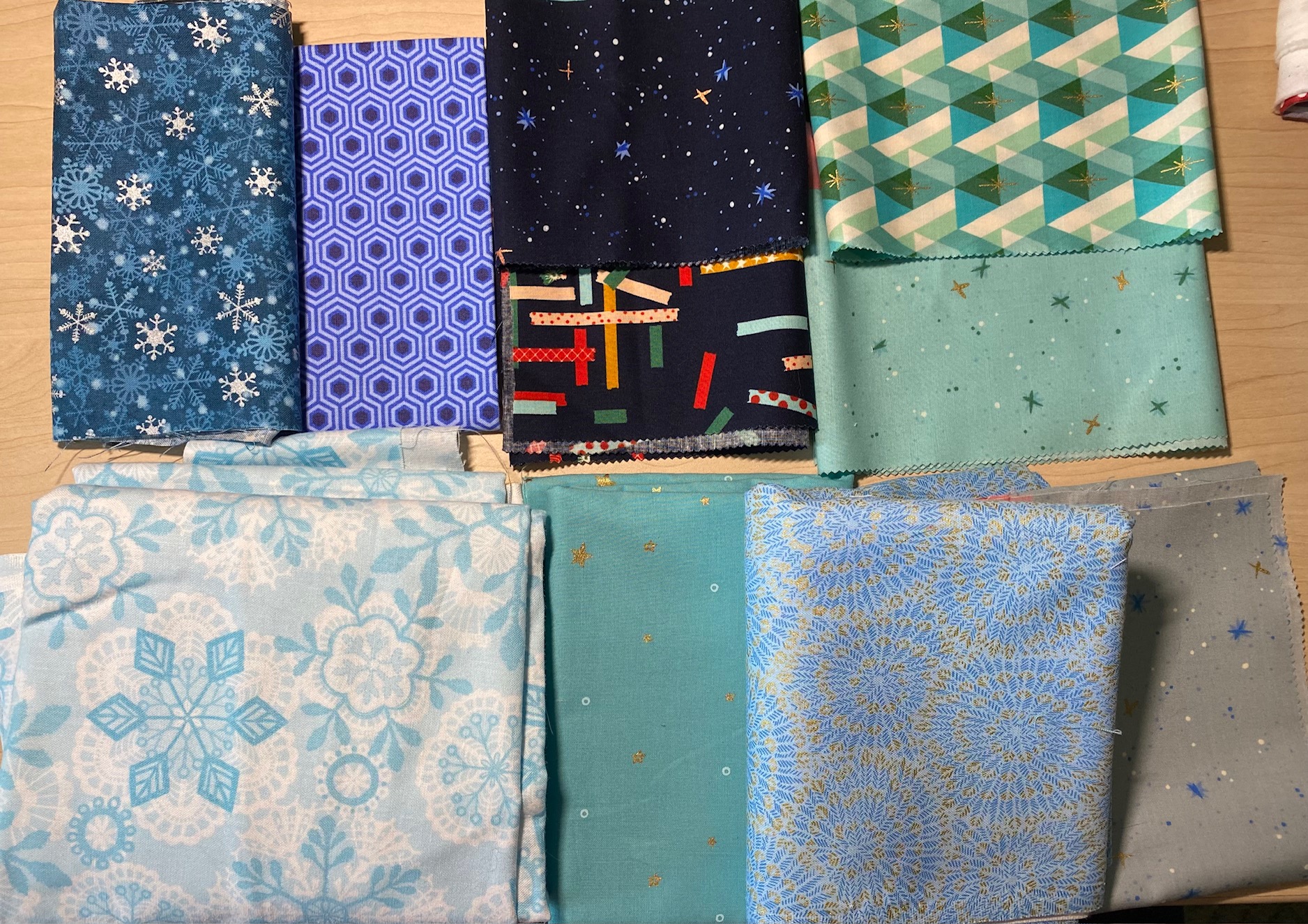
I think the blue fabrics could be a range from dark blue to light blue with even some light green-blue colors as well.  That one fabric in my blue picture is not gray but light blue.  I know it appears like that in the picture.

For the background, please keep it to white fabrics.  I am fine with white-on-white designs, but I want it to go together as much as possible so please try to avoid the creams.  For the beard, I used a different white than the background, more a white-on-white design.

There might be other color combinations that work really well together so please be creative.  Like a green hat?  What would a non-traditional Christmas color look like?  Like if you had a pink Christmas pattern?  Let me know if you have questions around color combinations.

Below are some examples from my stash.  

Green:                                                                                     Blue:


Red:                                                                                 White:


For the nose, I sized down the template that comes with the tutorial.  I basically sized the pattern down 25% but I just winged the nose.  If you are concerned about sizing the nose down on the fly, I am happy to add the noses to final squares myself.  I have enough Heat n Bond to do that and lots of different skin type fabric.  So, feel free to send them without the noses!  See below for the difference between the two sizes - the grey oval is the nose that I sized down:


Cuts:

  • Background (white fabrics)
    • 2 squares, 5" x 5"
    • 2 squares, 2" x 2"
  • Body or Shirt fabric (red in the tutorial)
    • 2 rectangles, 2" x 3.5"
    • 2 squares, 3.5" x 3.5"
    • 1 rectangle, 2" x 9.5"
  • Hat fabric (blue in the tutorial)
    • 1 rectangle, 5" x 9.5"
  • Beard fabric (white fabrics)
    • 1 rectangle, 3.5" x 6.5"
Thank you in advance for helping me to put this together.  I am excited to see the varied fabrics and color combinations that you all come up with.  Again, if you have questions, please let me know.  
Thanks, and happy quilting!
Beth

Stashbee Hive 2- June- Improv Curves for Emily!!


Improv Curves!

Promise- not scary!

This idea was inspired by this video https://youtu.be/5Trgij2tync?si=2SxMDw54YPosrmbf

She gives good instructions too (and visual ones since it’s a video)- but she only uses 3 fabrics and 2 cuts and I would like 4 fabrics and 3 cuts. Also- she doesn’t have a "straight edge" side like I need- as explained in the sewing instructions below. 

Please read all instructions first. It's not hard, but it's good to know what you are doing and understand the why before you start. 


We will wind up with 4 pieces that I am considering 1 total square- but that’s a GRAND TOTAL of 3 cuts and 12 seams. And I expect it to be wonky as all get out- so no pressure! I had never done this before either but I wanted to try something new and gentle- non-patterned- mistake-friendly curves won.

Fabric Pull:  we need 4 x 12” squares- 1 square from each fabric:

With all fabric- while in general patterns are ok, please stay away from actual images- no ducks or santas or whatever. Think mostly blenders- so think abstract or at least really not-obvious. note: for "white" cream is also ok- as long as it's a lighter cream, don't go too far towards tan. I am trying to stay on the black/white/grey spectrum for those shades. 

1st fabric- Reads REALLY dark- like black- dark grey is fine, patterns are fine try not to have much of any color besides white, grey, & black (though a little sprinkle is fine- you can see I have some gold bits on one of mine)

2nd fabric- Reads close to white- can have a little bit of black and/or grey to break it up- patterns are fine try not to have much of any color besides white, grey, & black (though a little sprinkle is fine)

3rd fabric- Reads white & black, but is in the middle of the above 2- patterns are fine try not to have much of any color besides white, grey, & black (though a little sprinkle is fine)

(soo...1 dark, 1 light, 1 medium)

4th fabric- something that reads as a solid color- doesn’t need to BE a solid color- just needs to read as one. Batiks are fine. I like bright, bold colors- not neutrals. We are looking for high contrast pop between this and the 3 other black/white/grey fabrics


Fabric Examples:


Cutting:

Stack all 4 of the 12” squares on top of each other, nice and tidy & all lined up. Doesn’t matter what order as we are going to rearrange all the stacks once cut anyway.

Figure out if you are more comfortable swinging your cutter left to right or right to left- I did this by swinging my hand and cutter both ways until I knew which felt better.

Take a deep breath- You will only be making 3 cuts, all starting on the bottom edge and going either to the right side or to the left side- whichever you thought was most comfortable.

It is SUPER important that the 4 layers of fabric stay lined up together while you cut- the cuts need to match for sewing.

You want to keep the 3 cuts at least 1.5” in width for easier sewing. Also- we want them to be different widths- not all close to the same width (Which is what I did in the photo below because it was my first time- no one will die if they are pretty close so don’t panic too much about that).

I would recommend that that the first cut and third cuts be at least 2" from the edge for easier sewing- but these look better if they aren't exactly the same spacing for all cuts- some fat, and some thin is awesome. 

Now…CUT a rough arc. Not looking for perfection- just a fairly round-ish arc.

(I didn’t take a photo of this stage before I did the next thing- so this photo will serve for both steps)


OK breathe again.


Next step is basically the same as if you have ever done a stack’n’whack- we need to switch fabrics around so that the 4 squares each have 1 of the 4 fabrics

With 3 cuts you will have 4 sections- starting on either the small inside corner or the large outside edge- think of them as stacks A, B, C and D.

Stack A take the top 1 piece off and move it to the bottom

Stack B take the top 2 pieces off and move them to the bottom

Stack C take the top 3 pieces off and move them to the bottom

Stack D leave as is.

You will then have 4 stacks where each of the same layer is 4 different fabrics (see above photo). Perfect!


 Sewing:

Pick either the side where cuts start/stop- I used the bottom- but if the side is more comfortable to sew from then that's fine. Just do it the same for all 4 blocks. We will start all sewing on along the same edge to keep that 1 edge as "straight" as possible. Look at my photos- you can see 1 edge is "straight" (I do not mean perfectly straight- just...in coparion to eht other sewn side) and the other is severely stair-stepped.  The edge you chose is going to stay your “straight edge” This is the edge that you will start sewing on every time- so all edges of all pieces will line up along this edge- therefore keeping it “straight” (pretty close to straight, not perfect) 

I did not pin anything, but I did use my ¼” measurements like I usually do for a ¼” seam. It wasn’t perfect, and if your seams get a little fatter than ¼” that’s ok, but you don’t want them to be thinner.

Grab the top fabric from Stack  A and the top fabric from Stack B. Line up the cut edges on your chosen “straight” side, right sides together, and sew the curve.

Go slow, adjust fabric often.

The fabrics will NOT line up at final finishing edge/side- this is fine. You will in the end wind up with a “stair-step” on that side. Totally good.

(In the below image you can see I’ve chosen the bottom as my “straight” which made the left edge  a “stair step”)

 Once those 2 are together, take the top fabric from Stack C, right sides together with the 2-pieces unit you already have, lined up along the “straight” edge. And repeat sewing this one on.

And finally take the top fabric from Stack D and do it again.


TA-DAH! 1 block done!

Do that 3 more times with the remaining pieces. Fabrics should not duplicate within the same square.

Breathe again


Once all 4 blocks are together- press them

I pressed on the backside starting from the small cut corner and moving outwards- I did GENTLY pull my block as I went to help eliminate puckering and get those curved seams to lie flat.


Once pressed- ALL DONE!!!

Do not trim- just send them to me as is- stair steps and all.


End results as I want you to send them to me (again you can see 1 "straight-ish" edge which is the side where I started all  my sewing, and 1 "stair-step" edge which is the side I finished all my seams on). Also note how the different widths of cuts create more drama than similar widths.  (I have rotated the blocks here so to see the "circle" easier, but if they were all lined up the same, the "straight" side would all be on the same side)

Yes- please send the pressed BUT UNTRIMMED blocks. I will figure out a size I like once I have them all and trim them to that size.