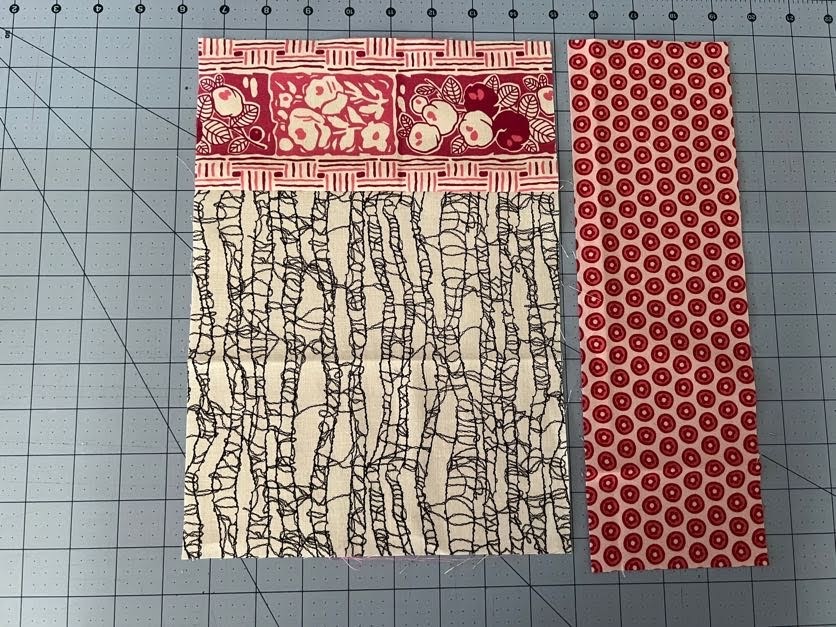
Hi Trishia, I made the improv version of the plus sign block (the lighter color is more light turquoise in person)😄 it’s on its way!

Trishia:
Thanks for offering so many variations. Made the layout much easier to work thru. Dropped in the mail yesterday.
Cindy


Hi Trishia,
Love your Colour Combo!
This block will start it's journey to you in the next couple of days.
Happy Quilting,
Rita
Dear Hive Mates,
Happy October! I am reaching out this month for a quick and easy block. This block is so easy that this tutorial may not even be necessary for most of you, as the assembly will come intuitively. I am hoping to have a variety of blocks that are not identical in the center size/placement. So, no stress, have fun!
With your help, I’ll be able to quickly prepare a lap size quilt for a friend.
Block: 10”x10” square block, with a square or rectangular center.
Fabric: The colors I have in mind are nothing inspired by the new Fall season! Instead, I am looking for a palette composed of lavender/dusty purple, raspberry/pink, aqua/turquoise, sage green and coral/red.
Inspired by this Kaffe Fassett fabric:


Please, *no* yellow, *no* bright orange.
Select two fabrics out of this palette, either solids, read solid or small flower prints (I love flowers). Batiks are fine. We will call one fabric “accent”, and one will be called “main”.
Cutting: I don’t have specific cutting instructions. You may even know intuitively how to prepare the block. If you want to use a larger center and make it fit in a 10”x10” block, go ahead! I am not looking for identical blocks, a little variety is nice, so you really cannot go wrong in making this block!
Should you need more precise directives, you may look at the Hive 1-April 2026 tutorial, available here
or you can follow along “a-b-c-d-e-f”:
a) One 3”-4” square or rectangular center using the accent fabric,
b) One 10.5” strip of the main fabric, as wide as what you selected in a),
c) Two 10.5” x 4” strips of the main fabric,
d) Cut the strip prepared in b) in two,
e) Sew each two sections prepared in d) on each side of the square/rectangular center prepared in a), and
f) Sew each strip prepared in c) along the strip assembled in e).


Press however you prefer. The square/rectangular center does not need to be centered! No need to trim down to a perfect 10”x10”.
Thank you all for your generous contribution to my project!
I’m so excited for another year with Stash Bee and I'm asking to add to my blocks from last year as I fell in love with each and every one!
BUT this year You can choose any color you want for the strips.
The Haphazard block is bright, it's scrappy, it's creative, it's versatile!!
I'm using My Poppy Makes for inspiration. You can find the quilt here: MY POPPET MAKES
I changed up the dimensions so we will end up with a 15” block.


Fabric:
Let’s keep this Bright!


Center Square: Black and white, typeset, tone on tone, white on white
Strips: Pick one favorite color from your stash, then select four different fabrics to use. If you like Pink, feel free to use that again!


Instructions:
Cut (1) 8.5” square from your center fabric.
Pick out your 4 different fabrics in your color line and cut strips.
(1) 4" by 8.5"
(2) 4" by 12.5"
(1) 4" by 16.5"
Sew the strips around the center square using a 1/4” seam and trim each strip after you sew it. The measurements I gave for the strips are oversized so you will need to trim down a bit after sewing. This is expected.
Your block should now measure around 15.5” but don't worry if it doesn't. This block isn't one that has to be exact and a little wonkiness is fine with me. Press seams as you like.

Now comes the fun part! Cut the block in half twice
(7 3/4” for those who want measurements)


Then turn each piece so that the center square is in each corner. It makes a plus sign pattern in the middle of the block. (it's ok for one strip fabric to end up in a row/column but if you want to move blocks around go right ahead and play around with the layout)

Sew the 4 pieces together. Your block should be around 15"
Press the seams as you like. Don't worry about trimming as I can do that later when assembling the quilt.

Hope you have fun with this quick and easy block!
Thanks, Laurie
I couldn’t decide which version I liked best, so it’s Choose Your Own Adventure time!
The blocks will go together to make our new living room throw for autumn. All of my living room throws coordinate with a painting my daughter made for me. It’s a copy of Modigliani’s Girl in a Red Party Dress, my favorite painting. So this one will be blues, browns, creams, and low volumes with splashes of warm colors to complement that fiery hair.


For all of these, Solids work. Prints are great! Think nature, autumn, geometric. Please no Christmas/winter, summer (I.e. beach balls or popsicles) or childish prints. I love butterflies, birds, and flowers so any of those you can squeeze in are greatly appreciated.
The base of each block is two nine patch sections. One will have a blue family plus sign. The other brown family plus sign. You can make both or just one.
For each plus sign 9 patch, you will need five (3*3in) squares of the main color family (blues or browns) and four (3*3in) squares of background fabrics plus fabric for the low volume square (more on that later).
For cutting, I like to stack about 5 fabrics aligned on an edge. I cut a clean line then cut another 3 inches away. Both are about 4 inches in length, parallel to one another. Then I fold back the excess fabric carefully leaving the 3in strip so I can cut the other direction to detach it from the main stack of fabric, then cut again 3 inches from that cut to finish the square.
Basically, I cut 3in squares from 3-5 fabrics at once rather than cutting individual squares as that would take forever. Below, you can see the initial two cuts (3in apart from one another, I made these cuts longer to make it easier for you to see) and the excess fabric carefully folded back so I can make the other two cuts to remove my squares from the fat quarters/fabric scraps. I had one long strip, so I placed that on top of the pile to ensure I’m not cutting that one short.

Once you have your squares, arrange in a plus sign pattern:

Sew together rows, press top and bottom row in towards the middle square. Press middle row out. Nest seams together and sew rows together.

Press again. If you like, you can spin the seams where four corners meet. I just learned this technique and love it!
Partner Squares, if you want
For the other square, you choose! It can be one cut of fabric, a four patch, a nine patch, or even a higher number of squares if you have a bunch of strips of light and low volume fabrics that you want to use up. These squares should end up being 8 inches. If you made both the brown and blue 9 patch, you’ll need two 8in partner squares. OR not, I can add those later. This is really open to what you want to make.

For partner squares, you choose one:
Single fabric: 8 inches square OR
Four patch: Four squares (4 ¼ inch each) OR
Nine patch: nine squares (3 inch each) tip, use the cutting method from the plus squares to make this go faster OR
More squares, strips even! If you have smaller squares in background fabrics or even if you want to do 3 strips of 3 inches x 8 inch, I’m okay with that! This throw is meant to be scrappy and a bit uneven so the partner squares don’t have to be 9 patches.
If you made both the blue and brown 9 patch with partner squares, the final layout has the plus blocks in opposite corners. Sew a plus block to a partner low-volume block. Repeat with the other set. Press. Sew together with the plus blocks on opposite sides so they are kitty corner from one another. Please don’t trim!

If you want to do something more modern and improv or if 9 patch blocks just aren’t your thing, you could make a variation of Pam’s Wonky Hashtag block, but you’d only need 2 colored strips and would cut down the middle(ish), sew in the first strip, press, then cut down the middle the other way for the second strip. The big difference besides the number of strips is that they should be straight instead of angled, they just don’t have to be right in the middle of the block if you don’t want.

I made a version of that with process pics on my Instagram if anyone is interested in going that route. Just email the group and I'll send my link.
I started with 10 inch squares but you could do any size. For the gold my strips were 1.5in and for the blue they were 2in. I’m ok with any square 10 inches or smaller- I plan to use improv log cabin around smaller blocks to get everything to fit together. If one of you has more patience than me, you could even do a bunch of small 4 inch squares with 1 or 3/4 inch strips. Whatever makes you enjoy this month’s block works for me! The variety will make the finished quilt all that much better!
This is a lot of info, hopefully not too much. Please email if you have questions.
Hello!
I'm working on a round robin quilt challenge for my guild and am stuck on the last round, diamond in a square blocks!
Here's the quilt so far -- it all started with an orphan block :) We've had stripes and HSTs and text and now it's time for the diamond in a square blocks.

I would love you to make me one or two blocks either 8.5" unfinished or 6.5" unfinished.
COLOURS AND PATTERNS:
I'd like solids, blenders, geometrics, stripes, modern prints in colours drawn from the work in progress::
White, red, blues, yellow, gold, greens, teal. A little bit of another colour is no problem in a print! Text is fine, as long as it's not religious or political. My orphan block was made with Japanese fabric so if you have a bit of that kind of cotton it would be lovely.
You'll generally want one fabric for the central diamond and another contrasting fabric for the triangles around it, but if you want to make it more scrappy go ahead and mix up those triangles!
CONSTRUCTION OPTIONS
FOUNDATION PAPER PIECING a 6" finished (6.5" unfinished) block
There's a great tutorial at Generatiions Quilt Patterns which goes through all the ways of making a square (or diamond) in a square blocks in different sizes, with free printable Foundation Paper Piecing patterns for all sizes up 7" finished, so if you prefer FPP you could use the 6" finished (6.5" unfinished) pattern!
TRADITIONAL PIECING (both sizes)
I'm going to go through the steps of making an 8.5" unfinished block with piecing and with very generous margins so we have lots of room to trim it down to size :) I'll also give the cut list for making a 6.5" unfinished block the same way.
If you are a very precise piecer you could follow the formula given in this link from Farm and Folk, but I really like having wiggle room and I prefer my diamond in a square blocks to have a tiny margin around the diamond after they're sewn into the quilt. But I am so relaxed about this I can barely sit up straight so all will be good :)
CUTTING
For 8.5" unfinished block:
A: cut 1 6" square
B: cut 2 6" squares to contrast with A
cut these two 6" squares on the diagonal giving you four triangles
For 6.5" unfinished block
A: cut 1 4.5" square
B: cut 2 4.5" squares to contrast with A
cut these two 4.5" squares on the diagonal giving you four triangles


ASSEMBLING:
fold square A in half horizontally and crease to establish centre of opposite sides.
pin 2 triangle Bs on opposite sides of the square, right sides together, lining up the points of the triangles to meet the creases.
Sew quarter inch seam. Press away from centre.

Trim off doglegs.

fold A in half to crease centre of remaining sides.. Pin last two triangles to A, right sides together matching triangle points to crease and sew a quarter inch seam. Press away from centre. (yes, it's a different set of fabrics heh heh heh)

I was having huge problems trying to photograph stuff because of this little monster, Vittoria, the Adventure Cat, my sewing companion. Her thread-eating ways are why I will not be renovating my kitchen this year, but she's all better now, thankfully!

Trim unit to 8.5" (or 6.5") making sure you have fairly equal amounts (at least one quarter inch) away from each point of the central diamond. I'm fine if it isn't perfect, honestly. This whole thing is pretty improv! Thank you so very much, and I'm thrilled to be part of Stashbee again!


Thank you for getting me to finally take the plunge and figure out foundation paper piecing! This went much better than my first attempt a couple years ago, but I still feel like I have a lot to learn.


Dutchman’s Puzzle Block - 12.5” unfinished
I’ve wanted to make a quilt with this block for years…the thought of making so many geese is daunting though! This block is made from 8 flying geese. I think the 4-at-a-time method for the geese is easiest and quickest method but feel free to use whatever method works for you.
I love all colors and the brighter, more saturated, the better. I think a dark background makes colors really pop so this block uses black or very dark charcoal gray as the background/sky - no low volume or white to be found in this bee block!
You’ll make 2 sets of 4 geese and individual geese blocks should measure 3.5” x 6.5” unfinished.
Fabric requirements for 4-at-a-time geese:
Please use any two prints with high contrast such as:
-purple💜 & yellow💛
-blue💙 & green💚 (Go Seahawks!)
-neon pink💗 & orange🧡
or any color combination that use bright, saturated colors
This is a link to a tutorial I based my block on: https://www.ladybugthreads.com/may-dutchmans-puzzle-bom/
Below are pictures of the block I made.
Cut fabrics:

Draw diagonal lines on the back of the 4” squares and place 2 RST in opposite corners of each of the 7.25” squares so the lines match up. You’ll sew 1/4” on either side of the line:

Cut on the line and press the resulting black triangles away from the color triangle:

Lay a 4” square on the color corner as shown and sew 1/4” on both sides:

Cut on the line:

Press the black triangle away from the color to create your geese:

Trim all geese to 3.5” x 6.5” making sure to keep a 1/4” seam allowance at the top point of the geese:
I use a Creative Grids 3.5” x 12.5” ruler that has markings to make trimming at the top goose point easy. Trim top and bottom at 3.5” width and then trim the sides making sure the bottom of the geese measure 6.5” where the color and the background meet.

8 trimmed geese 🤩:

Layout geese in 4 identical sets of 2:

Sew the top goose to the bottom goose with a SCANT, 1/4”. I find it helpful to sew with the bottom goose on top so I can see the intersection of the stitching and aim to stitch through the intersection:


Press open and arrange the 4 geese blocks with points going in a clockwise direction as follows so a pinwheel forms as shown:

Sew as a four-patch:

Pin the centers and edge points of the final seam where they meet so the points don’t get lost in the seam allowance:

Ta-da! 👏👏👏 you've made a Dutchman’s Puzzle:

EXTRA CREDIT: The center of this block is very thick so I spin the center by clipping a couple of the stitches and pressing each half of the last joining seam to the left. If you don’t want to mess with cutting stitches to spin the centers, don’t worry about it. 😊

Thank you for helping me make this Dutchman’s Puzzle quilt 😊